March 24th, 2026
hunningham: Beautiful colourful pears (Default)
posted by [personal profile] hunningham at 09:22pm on 24/03/2026
I always make my own cards for valentine's day, because commercial cards just do not hit that sweet spot. This year - nice picture of a prehistoric armoured lump of a crab with "Our Love is like a Horseshoe Crab" (Totally not original - plagiarised from Valentine's Day for Naturalists by Bird & Moon comics)

The card is still on the mantelpiece because Himself really likes it. Last week I had the chimney swept. The sweep was too polite to comment directly, but he was giving it some serious side-eye inbetween chatting about chimney copings.
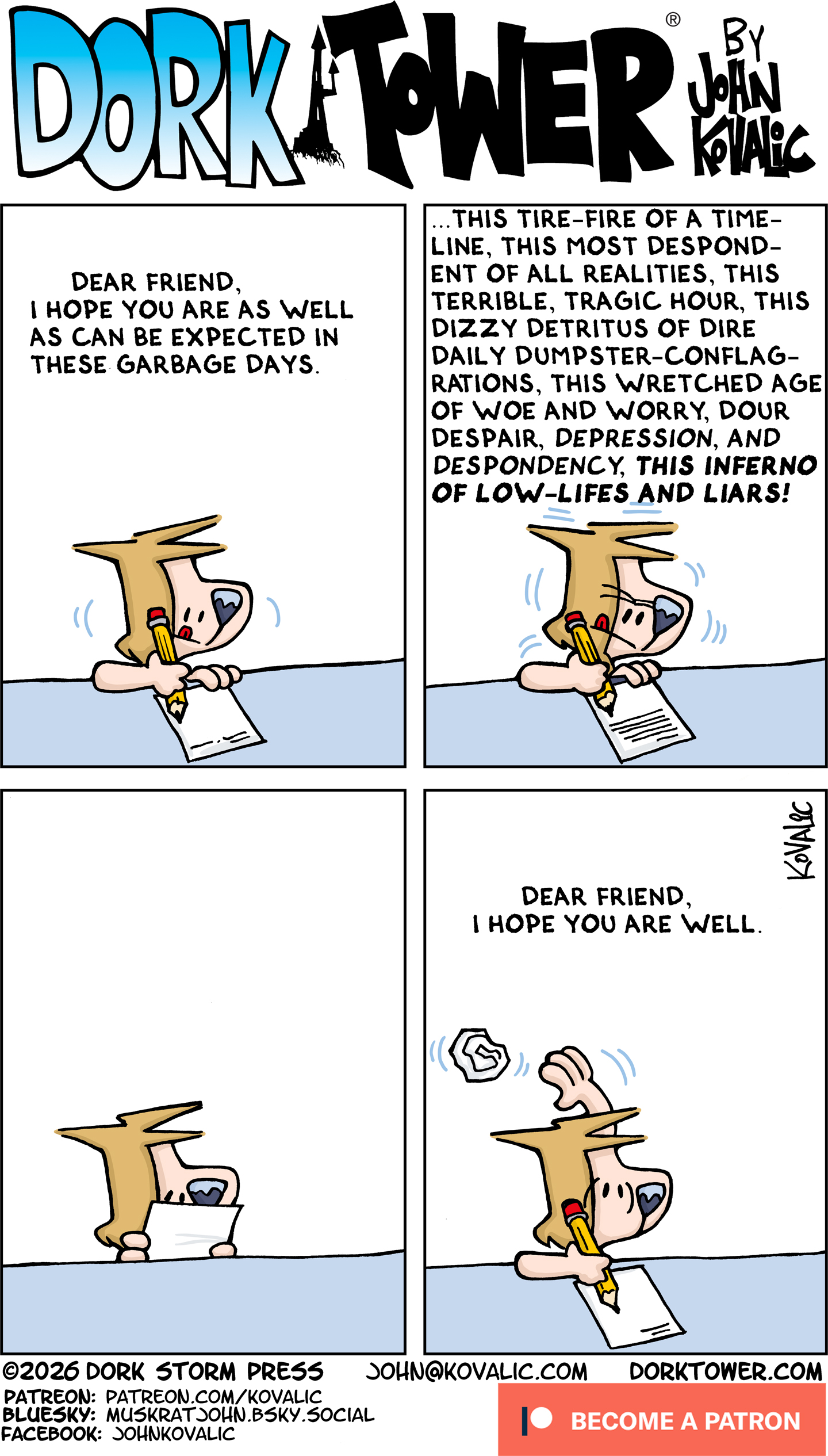
posted by [syndicated profile] dorktower_feed at 05:00am on 23/03/2026

Posted by John Kovalic

Most DORK TOWER strips are now available as signed, high-quality prints, from just $25!  CLICK HERE to find out more!

HEY! Want to help keep DORK TOWER going? Then consider joining the DORK TOWER Patreon and ENLIST IN THE ARMY OF DORKNESS TODAY! (We have COOKIES!) (And SWAG!) (And GRATITUDE!)

nineveh_uk: Illustration that looks like Harriet Vane (Default)
posted by [personal profile] nineveh_uk at 08:12pm on 24/03/2026 under
Well it was for a few days. But it is the nature of spring to be fickle, so I shall endure the appearance of equinoctial gales and hope that the cherries don't blossom until later in the week or it will disappear in the closest thing to a blizzard of this winter. I have been failing to write a post because I should be writing about seeing Peter Grimes (brilliant, very dramatic), or more Olympics, or visiting my parents, or reading A Month in the Country (rich and lovely) and it has not happened. Admittedly having a cold has not helped. And I certainly don't want to try to think of something to say about geopolitics.

So when I was reminded of the existence of this song/vid, I thought, I should post that. It is very relatable, literally and metaphorically. Who has never been the penguin who doesn't want to get out of his futon?

andrewducker: (Default)
posted by [personal profile] andrewducker at 08:02pm on 24/03/2026 under

The kids are watching an episode of SpongeBob where he's failing to write an essay. It is, frankly, stressing me the fuck out.

sovay: (Lord Peter Wimsey: passion)
posted by [personal profile] sovay at 02:24pm on 24/03/2026
My poem "ἀγκυλοθάλασσος" has been accepted by Strange Horizons. I am indebted to [personal profile] radiantfracture for his Twine prompt generator designed to produce scientific-sounding compound adjectives and nouns, in this case the irresistible "ankylothalassic" from ἀγκύλος "crooked, bent" and θάλασσα "the sea." I rendered it back into classical Greek and José Esteban Muñoz and Twelfth Night got in there along the way. It was written on New Year's Eve.

While I was out of ambit of the internet for almost all of yesterday, Reckoning: It Was Paradise hit the digital shelves. It is the special issue of the journal of environmental justice on war and conflict and contains a poem of mine which will go live on the internet in a month, or you could pick it up now with the rest of the shatteringly topical e-book if you don't feel like preordering it in print. I wrote it last summer after the—first—U.S. strikes on Iran. I taught myself a small amount of Elamite cuneiform for it. It should not have come around to such relevance again.

The designer of the Paleontological Research Institute's long-running pre-saurian Paleozoic Pals has just branched out into Pleistocene mammals with a Kickstarter for Cenozoic Snuggles. I have put in for a Glyptodon.

I may have slept nine hours. I just heard Rabbitology's "The Bog Bodies" (2026).
Music:: Charlotte Sands, "Satellite"

Posted by Athena Scalzi

You know ’em, you love ’em, authors Tiffani Angus and Val Nolan are back again with another installment of their speculative fiction guidebooks. Hop on board the Big Idea to see how they’ve done it again in Spec Fic for Newbies Vol. 3: A Beginner’s Guide to Writing Even More Subgenres of Science Fiction, Fantasy, and Horror.

TIFFANI ANGUS & VAL NOLAN:

Imagine a classic scene: A car driving down a lonely rural road… a bright light overhead… an examination table aboard an alien spacecraft… and then, instead of the typical medical business, our protagonist—let’s call her Sally—finds herself sitting across from an extraterrestrial. This being communicates with a curious thought-to-text translator device it places on the table. When the entity speaks, its words appear in the air between them:

“My species has learned all we can about your physiology. Now we wish to know about your culture. Does your society… tell stories?”

Sally, who’s been studying Creative Writing, is only too happy to discuss this. “We sure do,” she says. “Lots of different kinds! Science Fiction stories, Fantasy, Horror. And they take all sorts of different forms, like written fiction, TV shows, comics books…”

The alien’s already wide eyes expand even further. “And your species just instinctively understands how to tell these stories?”

“I mean, kinda. We’ve been doing it since we sat around campfires in the Ice Age. But we benefit from practice, you know? Plus, it helps to have guidance from enthusiastic instructors. Not literary snobs who want to make everyone write the same way as them but people sympathetic to the kinds of stories you want to tell.”

“And does one need to go to a school or university for this?”

“Not necessarily. Some people who’ve taught Creative Writing at universities have written books about it.” Sally looks around, finds her backpack (which conveniently materialized beside her), and pulls out a copy of Spec Fic for Newbies Vol. 3: A Beginner’s Guide to Writing Even More Subgenres of Science Fiction, Fantasy, and Horror by Tiffani Angus and Val Nolan. “This, for example, helps novice scribblers and even more seasoned writers learn how to write thirty different subgenres and major tropes. It gives deep dives into the history and development of each subgenre or trope, offers spotter’s guides to their typical manifestations, and provides writing exercises to get you started. Plus, it’s all based on real classroom experience!”

“Subgenres…” The alien’s word floats in the air. “We have heard of these. So many to keep track of.”

Sally thinks about this for a moment. She reaches for the translator. “Can I…?”

The alien nods.

Sally quickly finds the translator’s settings and alters a couple of font choices. “There,” she says, returning the device, “I’ve set it so that when I mention a subgenre that’s in Spec Fic 3, it will appear in bold. That’s what they do in the book. Like all this”—she gestures around the silver room—“is a recognizable Alien Abduction narrative. But the book covers everything from Dinosaur Tales to Swashbuckling Fantasy to Fungal Horror to Superheroes.”

“Fascinating.” The alien considers the book. “I wish I’d been able to study this.”

“They don’t teach Creative Writing at Space Academies?”

“Our universities mostly produce Mad Scientists,” the alien says. “Oh!” It points at the bolded word. “It did the thing!”

Sally smiles. “It’s fun, isn’t it? Plus, when Angus and Nolan discuss subgenres in the other volumes of the series, they underline its name so you can track it down easily.”

“Yes.” The alien turns Spec Fic for Newbies over in its spindly fingers. “I was wondering: can I just jump in with this third volume?”

“Oh absolutely! They’re all stand-alone books. Though if you want to know more about the previous ones…” She takes out her phone. “Have you got wi-fi here? Like, space wi-fi?”

The alien turns the translator upside down and shows her the password.

“Okay, cool,” Sally says, logging on. “So, Angus and Nolan have written about the previous volumes on Scalzi’s blog. You can read about Volume One here and Volume Two here.” She passes her phone to the alien, who reads the blog posts with interest.

“And people find these guides useful?” it asks.

“Useful and enjoyable,” Sally says. “The first two volumes were included on the Locus Recommended Reading List and shortlisted for the British Science Fiction Association Awards and British Fantasy Awards. Those are, like, big deals on our planet.”

“The section on Magic Schools and Dark Academia sounds interesting,” says the alien, now looking through the table of contents. “As does the section about Magical Realism.”

“I like some of the horror stuff myself,” Sally says. “I’ve lately given a go to writing about Near Death Experiences and Urban Gothic and Weird Fiction.”

“And?”

“And I’ve been trying lots of things that I never thought I’d try. The book is really encouraging that way. Angus and Nolan don’t believe in gatekeeping. The whole ethos of Spec Fic for Newbies revolves around bringing people into the realms of Science Fiction, Fantasy, and Horror by giving them the tools to explore these really rich and rewarding imaginary worlds.”

“I see there’s lots of jokes, too,” the alien says, the translator registering its chuckles as a series of curious emojis. 

Sally makes an affirmative noise. “Yeah, the authors have a really snarky sense of humor. Angus and Nolan don’t take themselves too seriously, which is another thing that separates this book from the really dry, old-school academic writing guides. Though, of course, that doesn’t mean the book isn’t smart—”

The alien holds up the section on End of the Universe stories. “I can see that.”

“—but it does mean it’s approachable. Anyone can read Spec Fic for Newbies. Anyone can learn from this book. That’s their big idea!”

Bugs!!!” the alien suddenly shouts.

“Where?!”

“Page 229!”

Sally laughs. “I haven’t got to that part yet!”

“This book tells us much about humanity,” the alien says, “as well as things about Elves and Kaiju.”

“And we’ve barely even covered half of the subgenres here!”

The alien returns the book to Sally. “Where can I get my own copy?”

“Direct from Luna Press.” She opens up the website. “Or from any of your usual retailers.”

“I think I would like to beam down and pick one up right away!”

“Great,” says Sally, “let’s go get you writing!”


Spec Fic For Newbies Vol. 3: Amazon|Barnes & Noble|Amazon UK|Blackstone UK|Waterstones UK

Author socials: Tiffani’s Website|Val’s Website|Tiffani’s Bluesky|Vals’ Bluesky

oursin: Brush the Wandering Hedgehog by the fire (Default)

Okay, it was lovely to see the heron again on my walk today. I wonder if it had decided that the eco-pond, with its shoals of Invasive Predatory Goldfish which people have dumped in it to the detriment of other life (frogs, newts, dragonflies) is a delicious all-you-can-eat buffet.

Assuming it is the same heron and that the first did not just tell a friend.

***

In more annoying news, today partner had a go at fixing my printer, which has been giving 'Paper Jam in Tray 1' error messages -

- and after doing pretty much the equivalent of open heart surgery on the thing, lo and behold, there was, entirely concealed from view, a page jammed in the works.

I depose that having to eviscerate a printer to discover this is something of a design fault?

Unfortunately, once the printer was put back together, it decided that the gate was open and it was not going to print anything.

Partner is going to have another go at it tomorrow, but I suspect that New Printer is in the future.

***

Meanwhile, I copied my paper for tomorrow to a memory-stick and took it to partner's computer so that I could print it out there.

This was accomplished successfully.

The famous article Choose Boring Technology lists two problems with using innovative technology:

  1. There are too many "unknown unknowns" in a new technology, whereas in boring technology the pitfalls are already well-known.
  2. Shiny tech has a maintenance burden that persist long after everybody has gotten bored with it.

Both of these tie back to the idea that the main cost of technology is maintenance. Even if something is easy to build with, it might not be as easy to keep running. We cannot "abandon" mission-critical technology. Say my team builds a new service on Julia, and 2 years later decides it was the wrong choice. We're stuck with either the (expensive) process of migrating all our data to Postgres or the (expensive) process of keeping it running anyway. Either way, the company needs to spend resources keeping engineers trained on the tech instead of other useful things, like how to mine crypto in their heads.

Tech is slow to change. Not as slow to change as, say, a bridge, but still pretty slow.

Now say at the same time as Julia, we also decided to start practicing test && commit || revert (TCR). After two years, we get sick of that, too. To deal with this, we can simply... not do TCR anymore. There is no "legacy practice" we need to support, no maintenance burden to dropping a process. It is much easier to adopt and abandon practices than it is to adopt and abandon technology.

This means while we should be conservative in the software we use, we can be more freely innovative in how we use it. If we get three innovation tokens for technology, we get like six or seven for practices. And we can trade in our practices to get those tokens back.

(The flip side of this is that social processes are less "stable" than technology and take more work to keep running. This is why "engineering controls" are considered more effective as reducing accidents than administrative controls.)

Choose Boring Material and Innovative Tools

Pushing this argument further, we can divide technology into two categories: "material" and "tools".1 Material is anything that needs to run to support the business: our code, our service architecture, our data and database engine, etc. The tools are what we use to make material, but that the material doesn't depend on. Editors, personal bash scripts, etc. The categories are fuzzy, but it boils down to "how bad is it for the project to lose this?"

In turn, because tools are easier to replace than material, we can afford to be more innovative with it. I suspect we see this in practice, too, that people replace ephemera faster than they replace their databases.

(This is a short one because I severely overestimated how much I could write about this.)


April Cools

It's in a week! You can submit your April Cools in the google form or, if you want to be all cool and techie, as a github PR.


  1. This is different from how we call all software "tools". 

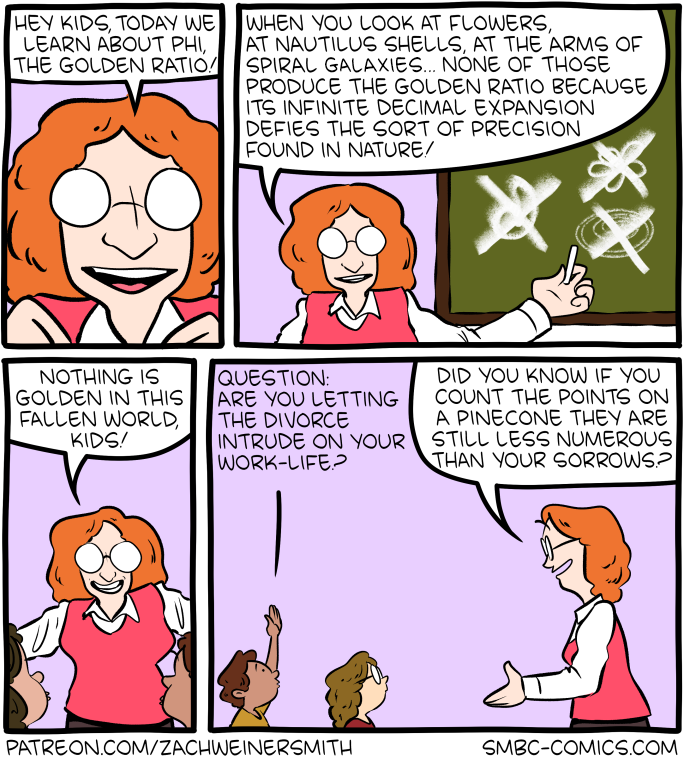
posted by [syndicated profile] smbc_comics_feed at 11:20am on 24/03/2026

Posted by Zach Weinersmith


Click here to go see the bonus panel!

Hovertext:
There should be demotivational youtube math videos. Just to be different.


Today's News:
james_davis_nicoll: (Default)


Telling the truth can make you unpopular... or put you into real peril.

Five Stories About the Dangerous Business of Truth-Telling
james_davis_nicoll: (Default)


A brief guide to creating plausible planets.

How to Build a Planet by Poul Anderson & Stephen L. Gillett
osprey_archer: (books)
(I actually wrote this review before my trip, then ran out of time to post it.)

Sometimes you just know, just from looking at a book’s cover, that this book is in some way For You. Such is the case with Sara Pennypacker’s Pax, with its Jon Klassen cover of a fox standing on a wooded hill gazing across a plain at a sunset. I’ve looked at this book for years and always meant to read it and somehow never quite picked it up.

But at last I’ve read it, and I was correct that it IS for me, full of solid fox action (which you would expect from the cover) and also surprisingly serious musings about war (which you would not guess from the cover, but it works).

War is coming to the country. Which country? The country, which is similar to America but perhaps not America. With whom? The enemy. What for? The water. Why? Because the humans are war-sick. This vagueness might not work for me in a different book, but here it works well to highlight the destructiveness of war, not only for people but for the land and the animals.

Peter’s father has joined the army. Since Peter’s mother is dead, he’s going to live with his grandfather, which means he needs to get rid of his pet fox Pax. So Peter’s father drives him to an isolated road, and Peter throws Pax’s favorite toy into the woods, and Pax chases after it.

But as soon as Peter arrives at his grandfather’s house, he realizes he’s made a horrible mistake. There’s nothing for it: he’s got to run away and trek cross-country to find Pax.

Meanwhile, Pax intends to sit by the side of the road and wait for his boy. But hunger and thirst force him to begin exploring the forest, where he meets other foxes… and they discover that the human armies are drawing closer.

Really enjoyed this. Great fox POV. There’s a sequel, so I don’t think it’s a spoiler to say that Pax lives. Don’t want to give too many spoilers, but I found Peter’s journey unexpected and satisfying, and Pax’s journey pretty much what you might expect from that summary but also satisfying. Sometimes stories hit certain beats for a reason, you know?
posted by [personal profile] jazzyjj at 06:38am on 24/03/2026 under
It's challenge time!

Comment with Just One Thing you've accomplished in the last 24 hours or so. It doesn't have to be a hard thing, or even a thing that you think is particularly awesome. Just a thing that you did.

Feel free to share more than one thing if you're feeling particularly accomplished!

Extra credit: find someone in the comments and give them props for what they achieved!

Nothing is too big, too small, too strange or too cryptic. And in case you'd rather do this in private, anonymous comments are screened. I will only unscreen if you ask me to.

Go!
cz_unit: (Default)
posted by [personal profile] cz_unit at 07:21am on 24/03/2026 under ,
One of the things I like to do in this journal is think about why I think and why I am. Existensial of course, but it's good for this.

Today's thought is about my tendency to castastrophise and where it came from. There is a funny comic about this, guy thinks about why he does what he does and the gist is this:

I tend to think in terms of stuff being 100% good, or 100% bad. It's something you get when you were an abused kid: When things are good they are good, but when things go bad it is a catastrophe of biblical proportions. And you try to bring it back to "good" and "good" just is an absence of "bad" but when you compare the two at like 8 you see good as pure bliss and bad as pure hell.

Nothing in between. Thus you don't learn about taking stuff in context; how can you explain to an 8 year old that your dad is an abusive drunk and you should take the beatings in the context of "this is wrong and not normal"? You just want it to stop and you pull every little lever you have to make it so.

Except you're 8 and those levers really don't do a whole lot. But they do teach you to avoid conflict and conflict=death.

And that's a problem for adult me that I have struggled with for a long time: If I see conflict I immediately throw everything at it to try and bring things back to "good". And when things are "good" I don't improve because well they are 100% good. So I get into this frame which is like the bank robber in the movie "Oh Brother where art thou".

In that movie George is a bank robber and is either happy as hell or massively depressed. He doesn't have a middle, just polar end states. And at the end of the movie when he is being taken away by the police and is happy as hell about it one of the characters observes:

"Oh good, Ole George is back on top!"

Yeah, I tend to be like that.

But I digress. Or maybe I don't. Hm. Point is I don't get to experience incrementalism (gradations of problems) or contextualization (looking at the other items that are happening around the problem) and instead I throw everything I have at FIXING the problem and making it go away.

What I don't have is predictive catastrophization. In other words I don't meet someone, see some tiny flaw that might become a point of conflict in the future, then decide to bail on them without trying because eventually it would come up, it would be a point of conflict, and since conflict=death the relationship or situation would blow up anyway and why should I even try?

Or.... Maybe I do. Sometimes opportunities come up and I analyze them, see the potential for problems, and just toss the thing out with the dishwater because "I have enough problems already". It might result in conflict so why bother?

There is a thing I say to myself: "When I was a kid, I had kid tools to deal with problems, but as an adult I have adult tools to deal with problems".

And adult tools are far more powerful and far more useful/dangerous to use.

I joke to myself when I say "This is a problem can be solved by MONEY!" but it's true: When we got to the hotel in Norway and they didn't have our reservation that night it could have been a disaster and I was just starting to fire up the fight or flight response when that little voice in my head said "Wait, we can solve this with MONEY!" and I just paid for another night. Simple, $200 bucks, would have spent it anyway, not a disaster.

Just throw a small amount of money at the problem instead of going completely insane about it. That's an adult way to deal. Get people together and embrace differences of opinion and come to a consensus instead of throwing everything you have to "fixing" the problem yourself. Have some trust in other people, you're not living in a den of vipers.

Except..... This sort of mental state is probably not unique to me. I'd bet that a lot of people who were pounded as kids by parents who forced right and wrong into their brains have this trigger. And someone like Trump is just the person who knows how to use it.

From the "Daddy's back" bullshit to the stern image of a father about to beat you with a belt (he's an 80+ year old shit) to his attempts at "awesome retribution" towards anyone who tries to resist in any way this trips that "conflict=catastrophe" bit and leads to people either doing anything he wants or going nuts preparing for the "consequences". I'm sure it works on people who see the world as 100% good and 100% bad. Set up a fake conflict and watch people cave or try to bring it back to 100% "good".

There is no 100% good. And 100% bad is possible, but not too likely. Context does matter and yes the world is quite fucked up at the moment. But that's context, you can't magically pull it back to 100% good alone that will take time and dealing with stuff with adult tools. And the 100% "bliss" from complete submission is like the 100% bliss as a kid, a false place of security which you can't control and can go awesomely bad as you're basing good and bad on a drunk dad who is quite honestly random.

Sigh, lot of thoughts this morning. Dreamed I was at college taking notes for an engineering class on "engine efficiency" and the professor was writing tons of formulae on the blackboard and I was trying to write them down but I had a sharpie instead of a pen and the letters just bleed and blur on the paper so I could not read the subscripts. Complete mess.

Ok, it's now 7:15 and I have to get to work. There is a small catastrophe going on and I woke up at 6am so I could go in personally and save things. Except Alex is sick, the dog needs to be walked, and I can't take care of her and the disaster. So I'm not going to go in and instead will fix it remotely and walk the dog/be there for Alex.

It's not going to result in my job going away and even if that happened I have enough $$$ to last for a couple of years.

So it will be ok. No need to freak out and assume it's 100% or 0%. There are gradations, that is life.

More later.
posted by [syndicated profile] bruce_schneier_feed at 11:03am on 24/03/2026

Posted by Bruce Schneier

Japan’s election last month and the rise of the country’s newest and most innovative political party, Team Mirai, illustrates the viability of a different way to do politics.

In this model, technology is used to make democratic processes stronger, instead of undermining them. It is harnessed to root out corruption, instead of serving as a cash cow for campaign donations.

Imagine an election where every voter has the opportunity to opine directly to politicians on precisely the issues they care about. They’re not expected to spend hours becoming policy experts. Instead, an AI Interviewer walks them through the subject, answering their questions, interrogating their experience, even challenging their thinking.

Voters get immediate feedback on how their individual point of view matches—or doesn’t—a party’s platform, and they can see whether and how the party adopts their feedback. This isn’t like an opinion poll that politicians use for calculating short-term electoral tactics. It’s a deliberative reasoning process that scales, engaging voters in defining policy and helping candidates to listen deeply to their constituents.

This is happening today in Japan. Constituents have spent about eight thousand hours engaging with Mirai’s AI Interviewer since 2025. The party’s gamified volunteer mobilization app, Action Board, captured about 100,000 organizer actions per day in the runup to last week’s election.

It’s how Team Mirai, which translates to ‘The Future Party,’ does politics. Its founder, Takahiro Anno, first ran for local office in 2024 as a 33 year old software engineer standing for Governor of Tokyo. He came in fifth out of 56 candidates, winning more than 150,000 votes as an unaffiliated political outsider. He won attention by taking a distinctive stance on the role of technology in democracy and using AI aggressively in voter engagement.

Last year, Anno ran again, this time for the Upper Chamber of the national legislature—the Diet—and won. Now the head of a new national party, Anno found himself with a platform for making his vision of a new way of doing politics a reality.

In this recent House of Representatives election, Team Mirai shot up to win nearly four million votes. In the lower chamber’s proportional representation system, that was good enough for eleven total seats—the party’s first ever representation in the Japanese House—and nearly three times what it achieved in last year’s Upper Chamber election.

Anno’s party stood for election without aligning itself on the traditional axes of left and right. Instead, Team Mirai, heavily associated with young, urban voters, sought to unite across the ideological spectrum by taking a radical position on a different axis: the status quo and the future. Anno told us that Team Mirai believes it can triple its representation in the Diet after the next elections in each chamber, an ostentatious goal that seems achievable given their rapid rise over the past year.

In the American context, the idea of a small party unifying voters across left and right sounds like a pipe dream. But there is evidence it worked in Japan. Team Mirai won an impressive 11% of proportional representation votes from unaffiliated voters, nearly twice the share of the larger electorate. The centerpiece of the party’s policy platform is not about the traditional hot button issues, it’s about democracy itself, and how it can be enhanced by embracing a futuristic vision of digital democracy.

Anno told us how his party arrived at its manifesto for this month’s elections, and why it looked different from other parties’ in important ways. Team Mirai collected more than 38,000 online questions and more than 6,000 discrete policy suggestions from voters using its AI Policy app, which is advertised as a ‘manifesto that speaks for itself.’

After factoring in all this feedback, Team Mirai maintained a contrarian position on the biggest issue of the election: the sales tax and affordability. Rather than running on a reduction of the national sales tax like the major parties, Team Mirai reviewed dozens of suggestions from the public and ultimately proposed to keep that tax level while providing support to families through a child tax credit and lowering the required contribution for social insurance. Anno described this as another future-facing strategy: less price relief in the short term, but sustained funding for essential programs.

Anno has always intended to build a different kind of party. After receiving roughly $1 million in public funding apportioned to Team Mirai based on its single seat in the Upper Chamber last year, Anno began hiring engineers to enhance his software tools for digital democracy.

Anno described Team Mirai to us as a ‘utility party;’ basic infrastructure for Japanese democracy that serves the broader polity rather than one faction. Their Gikai (‘assembly’) app illustrates the point. It provides a portal for constituents to research bills, using AI to generate summaries, to describe their impacts, to surfacing media reporting on the issue, and to answer users’ questions. Like all their software, it’s open source and free for anyone, in any party, to use.

After last week’s victory, Team Mirai now has about $5 million in public funding and ambitions to grow the influence of their digital democracy platform. Anno told us Team Mirai has secured an agreement with the LDP, Japan’s dominant ruling party, to begin using Team Mirai’s Gikai and corruption-fighting Mirumae financial transparency tool.

AI is the issue driving the most societal and economic change we will encounter in our lifetime, yet US political parties are largely silent. But AI and Big Tech companies and their owners are ramping up their political spending to influence the parties. To the extent that AI has shown up in our politics, it seems to be limited to the question of where to site the next generation of data centers and how to channel populist backlash to big tech.

Those are causes worthy of political organizing, but very few US politicians are leveraging the technology for public listening or other pro-democratic purposes. With the midterms still nine months away and with innovators like Team Mirai making products in the open for anyone to use, there is still plenty of time for an American politician to demonstrate what a new politics could look like.

This essay was written with Nathan E. Sanders, and originally appeared in Tech Policy Press.

posted by [syndicated profile] schneier_no_tracking_feed at 11:03am on 24/03/2026

Posted by Bruce Schneier

Japan’s election last month and the rise of the country’s newest and most innovative political party, Team Mirai, illustrates the viability of a different way to do politics.

In this model, technology is used to make democratic processes stronger, instead of undermining them. It is harnessed to root out corruption, instead of serving as a cash cow for campaign donations.

Imagine an election where every voter has the opportunity to opine directly to politicians on precisely the issues they care about. They’re not expected to spend hours becoming policy experts. Instead, an AI Interviewer walks them through the subject, answering their questions, interrogating their experience, even challenging their thinking.

Voters get immediate feedback on how their individual point of view matches—or doesn’t—a party’s platform, and they can see whether and how the party adopts their feedback. This isn’t like an opinion poll that politicians use for calculating short-term electoral tactics. It’s a deliberative reasoning process that scales, engaging voters in defining policy and helping candidates to listen deeply to their constituents.

This is happening today in Japan. Constituents have spent about eight thousand hours engaging with Mirai’s AI Interviewer since 2025. The party’s gamified volunteer mobilization app, Action Board, captured about 100,000 organizer actions per day in the runup to last week’s election.

It’s how Team Mirai, which translates to ‘The Future Party,’ does politics. Its founder, Takahiro Anno, first ran for local office in 2024 as a 33 year old software engineer standing for Governor of Tokyo. He came in fifth out of 56 candidates, winning more than 150,000 votes as an unaffiliated political outsider. He won attention by taking a distinctive stance on the role of technology in democracy and using AI aggressively in voter engagement.

Last year, Anno ran again, this time for the Upper Chamber of the national legislature—the Diet—and won. Now the head of a new national party, Anno found himself with a platform for making his vision of a new way of doing politics a reality.

In this recent House of Representatives election, Team Mirai shot up to win nearly four million votes. In the lower chamber’s proportional representation system, that was good enough for eleven total seats—the party’s first ever representation in the Japanese House—and nearly three times what it achieved in last year’s Upper Chamber election.

Anno’s party stood for election without aligning itself on the traditional axes of left and right. Instead, Team Mirai, heavily associated with young, urban voters, sought to unite across the ideological spectrum by taking a radical position on a different axis: the status quo and the future. Anno told us that Team Mirai believes it can triple its representation in the Diet after the next elections in each chamber, an ostentatious goal that seems achievable given their rapid rise over the past year.

In the American context, the idea of a small party unifying voters across left and right sounds like a pipe dream. But there is evidence it worked in Japan. Team Mirai won an impressive 11% of proportional representation votes from unaffiliated voters, nearly twice the share of the larger electorate. The centerpiece of the party’s policy platform is not about the traditional hot button issues, it’s about democracy itself, and how it can be enhanced by embracing a futuristic vision of digital democracy.

Anno told us how his party arrived at its manifesto for this month’s elections, and why it looked different from other parties’ in important ways. Team Mirai collected more than 38,000 online questions and more than 6,000 discrete policy suggestions from voters using its AI Policy app, which is advertised as a ‘manifesto that speaks for itself.’

After factoring in all this feedback, Team Mirai maintained a contrarian position on the biggest issue of the election: the sales tax and affordability. Rather than running on a reduction of the national sales tax like the major parties, Team Mirai reviewed dozens of suggestions from the public and ultimately proposed to keep that tax level while providing support to families through a child tax credit and lowering the required contribution for social insurance. Anno described this as another future-facing strategy: less price relief in the short term, but sustained funding for essential programs.

Anno has always intended to build a different kind of party. After receiving roughly $1 million in public funding apportioned to Team Mirai based on its single seat in the Upper Chamber last year, Anno began hiring engineers to enhance his software tools for digital democracy.

Anno described Team Mirai to us as a ‘utility party;’ basic infrastructure for Japanese democracy that serves the broader polity rather than one faction. Their Gikai (‘assembly’) app illustrates the point. It provides a portal for constituents to research bills, using AI to generate summaries, to describe their impacts, to surfacing media reporting on the issue, and to answer users’ questions. Like all their software, it’s open source and free for anyone, in any party, to use.

After last week’s victory, Team Mirai now has about $5 million in public funding and ambitions to grow the influence of their digital democracy platform. Anno told us Team Mirai has secured an agreement with the LDP, Japan’s dominant ruling party, to begin using Team Mirai’s Gikai and corruption-fighting Mirumae financial transparency tool.

AI is the issue driving the most societal and economic change we will encounter in our lifetime, yet US political parties are largely silent. But AI and Big Tech companies and their owners are ramping up their political spending to influence the parties. To the extent that AI has shown up in our politics, it seems to be limited to the question of where to site the next generation of data centers and how to channel populist backlash to big tech.

Those are causes worthy of political organizing, but very few US politicians are leveraging the technology for public listening or other pro-democratic purposes. With the midterms still nine months away and with innovators like Team Mirai making products in the open for anyone to use, there is still plenty of time for an American politician to demonstrate what a new politics could look like.

This essay was written with Nathan E. Sanders, and originally appeared in Tech Policy Press.

tamaranth: me, in the sun (Default)
posted by [personal profile] tamaranth at 09:56am on 24/03/2026 under ,
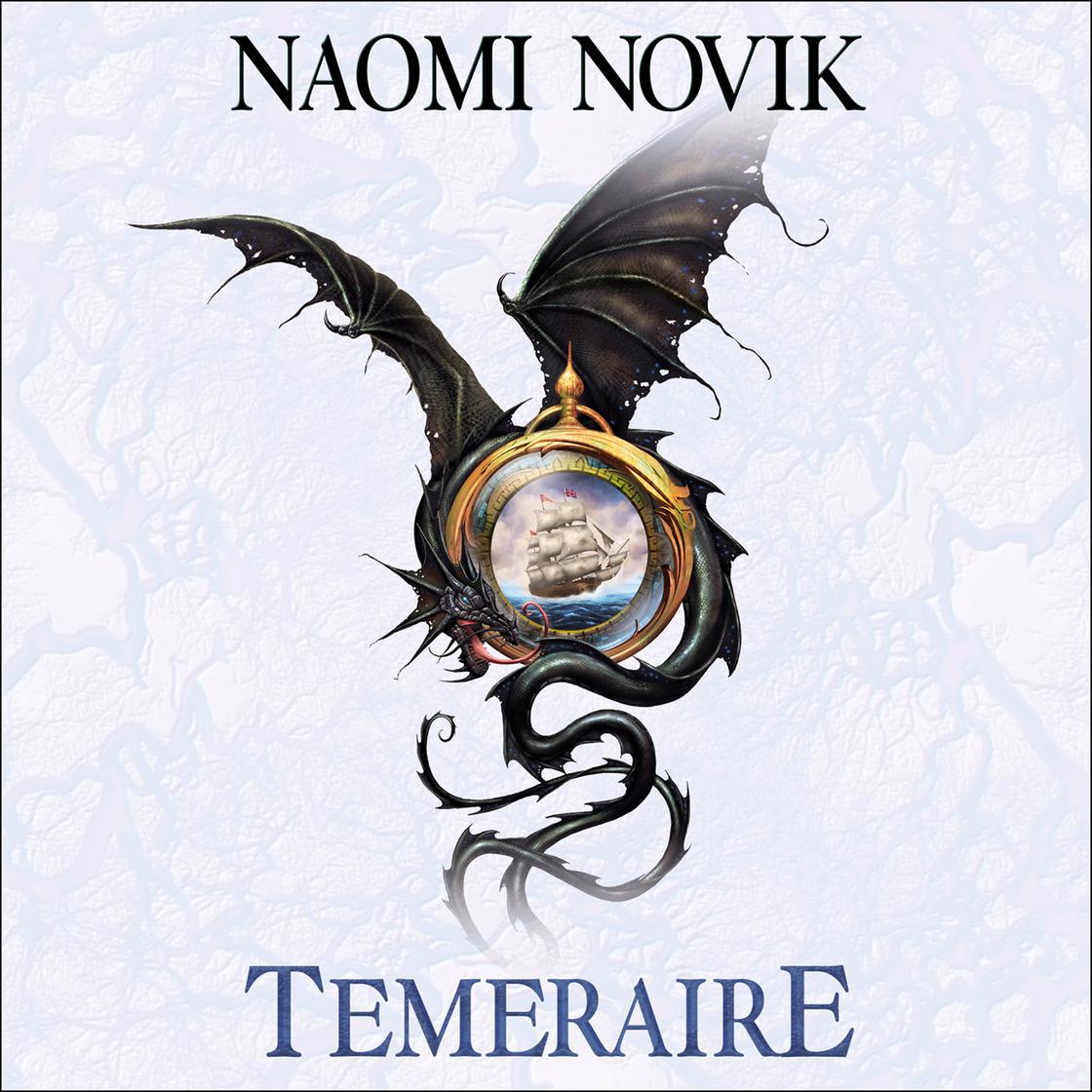
2026/041: Temeraire — Naomi Novik

You may value their lives above your own; I cannot do so, for to me you are worth far more than all of them. I will not obey you in such a case, and as for duty, I do not care for the notion a great deal, the more I see of it. [p. 196]

Audiobook reread: I first read this as an arc in 2005, and reread in 2019. I still love this book a great deal, and had a better sense of the pacing when I listened to the familiar procession of events. Splendidly read by Simon Vance, who gives Temeraire a very slight 'foreign' accent, perhaps hinting at his mysterious origins. I'm so tempted to buy the audiobooks of the whole series...

Mood:: 'cheerful' cheerful

November

SunMonTueWedThuFriSat
          1
 
2
 
3 4
 
5
 
6
 
7
 
8
 
9
 
10
 
11
 
12
 
13
 
14
 
15
 
16
 
17
 
18
 
19
 
20
 
21
 
22
 
23
 
24
 
25
 
26
 
27
 
28
 
29
 
30